
Abstract
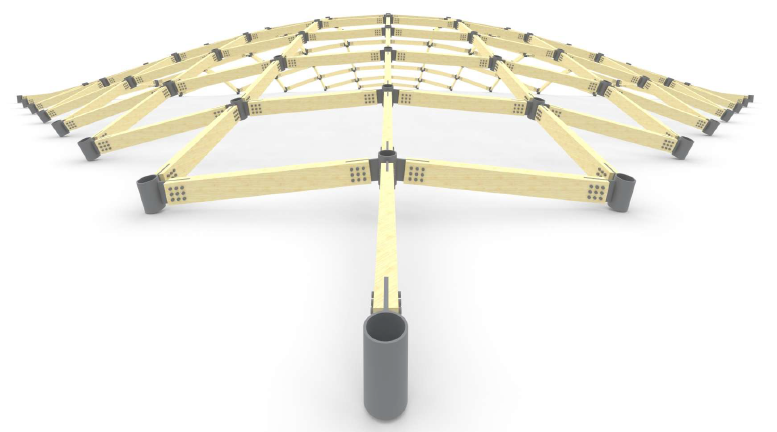
Unbraced timber gridshells provide a lightweight and materially efficient structural solution, but their structural response is highly sensitive to the rotational stiffness of their connections. In current engineering practice, timber connections are commonly idealised as either pinned or rigid, despite
exhibiting semi-rigid behaviour resulting from dowel bending, timber embedment deformation, and connection slip. Although Eurocode 5 provides practical stiffness formulations for dowel-type connections, several geometric and mechanical parameters that influence rotational stiffness are not explicitly accounted for.
This research develops a multi-scale analytical, numerical, and parametric framework that links the rotational stiffness of semi-rigid steel–timber knife-plate connections to the global behaviour of unbraced timber gridshells. A global parametric gridshell model is first used to establish the stiffness requirements associated with different grid configurations. Subsequently, beam-on-elastic-foundation formulations are developed to investigate the influence of geometric and material parameters on the linear elastic rotational stiffness of individual dowels and multi-dowel connection groups. The analytical formulations are validated using finite element simulations in MSC Nastran/Femap before being applied to the design of a practical connection through a full case study.
The results demonstrate that dowel diameter, embedment length, timber density, and bolt-group geometry all significantly influence rotational stiffness. Dowel diameter was found to produce the largest increase in stiffness. In contrast, embedment length exhibited the most complex behaviour, characterised by multiple plateau regions associated with changes in the dowel–timber contact mechanism. Comparison with Eurocode 5 indicates that the empirical slip-modulus formulation provides a practical design-oriented approximation but does not explicitly capture the additional stiffness resulting from finite embedment length and distributed dowel–timber interaction. Following calibration, the analytical formulation predicted the finite element results with an accuracy of approximately 5%.
At the global scale, the analyses demonstrate that the diagonal gridshell is governed predominantly by the out-of-plane rotational stiffness. In contrast, the orthogonal configuration exhibits a coupled dependence on both the in-plane and out-of-plane stiffness. The practical case study further demonstrates that the required global rotational stiffness can be translated directly into a feasible steel–timber connection satisfying both stiffness and strength requirements.
Overall, the proposed methodology establishes a direct relationship between local connection mechanics and global structural behaviour. By treating connection stiffness as a design variable rather than an assumed modelling parameter, the research provides a practical framework for stiffness-informed analysis and design of timber gridshells. It demonstrates the value of integrating analytical modelling, finite element analysis, and parametric design within a unified computational workflow.
Keywords: Timber Gridshells, semi-rigid connections, dowel-type connections, parametric study
Cite this: A Parametric Framework for Modelling the Influence of Semi-Rigid Connections on Unbraced Timber Gridshell Behaviour
Hasenaar, K.m. (Author). 09 Jun 2026
Access to document(s):