
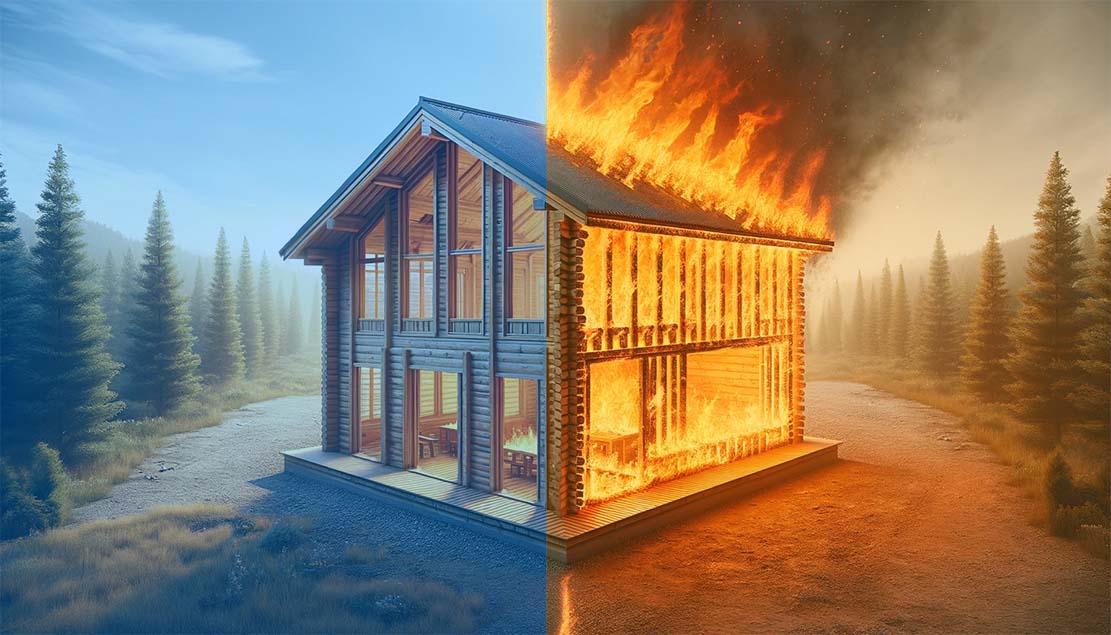
In most building codes personal safety of building occupants is the main objective. Because in most building codes an evacuation concept is applied in case of fire, a burn down scenario is acceptable, as long as there is enough time for building occupants to evacuate the building. Apparently, fire resilience is not a fire safety objective in the building code. The risk subsystems ‘fire and smoke resistance of compartment walls’ and ‘fire resistance of load bearing structure’ are so called Lines of Defence, they don’t need to be extremely reliable.
Both separation constructions and load bearing elements can be assumed to be fire safe, when the required safe time (RST: the thermal load by a natural fire, expressed in minutes standard fire) doesn’t exceed the available safe time (AST: the fire resistance of the construction in minutes standard fire). Both AST and RST apply to a thermal energy, expressed in minutes standard fire. The larger the interval is between AST and RST, the higher the safety level is. This can be expressed in a safety factor: AST = (safety factor) x RST. The safety factor decreases in case of combustible (biobased) building constructions.
What safety factor is needed according to the building code? What safety factor is needed for a fire resilient building? What is the influence of combustible building constructions, like CLT and other biobased materials on the fire resilience of buildings?