
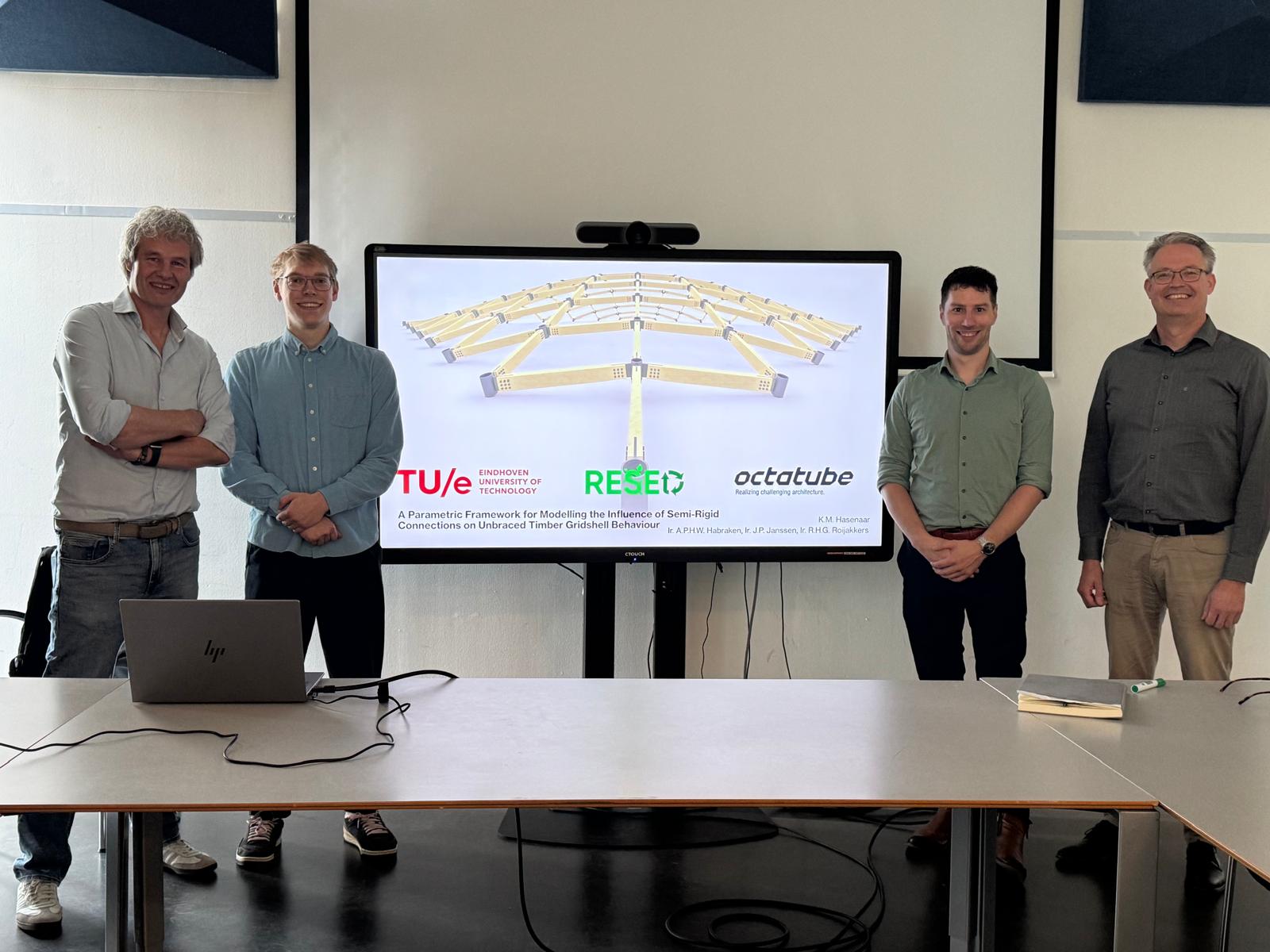
Researching semi-rigid timber connections for more reliable timber gridshells
Unbraced timber gridshells are lightweight, material-efficient structures that can create elegant curved roofs and canopies. Their behaviour, however, depends strongly on the stiffness of the connections between the timber members. In practice, these connections are often simplified as either pinned or rigid, while real steel–timber dowel-type connections behave somewhere in between. This semi-rigid behaviour is caused by dowel bending, timber embedment deformation and small amounts of connection slip.
This research develops a parametric framework to better understand how the rotational stiffness of semi-rigid steel–timber knife-plate connections influences the global behaviour of unbraced timber gridshells. A global gridshell model is first used to determine the connection stiffness required for different grid configurations. The study then zooms in to the connection level, using analytical beam-on-elastic-foundation models to investigate the influence of dowel diameter, embedment length, timber density and bolt-group geometry. These models are validated with finite element simulations in MSC Nastran/Femap and applied in a practical case study.
The results show that connection stiffness is influenced by several interacting parameters. Dowel diameter has the strongest direct effect, while embedment length shows a more complex response, including plateau regions linked to changes in the dowel–timber contact mechanism. Compared with the Eurocode 5 slip-modulus approach, the proposed analytical formulation gives a more detailed representation of finite embedment length and distributed dowel–timber interaction.
At structural scale, the research shows that diagonal gridshells are mainly governed by out-of-plane rotational stiffness, while orthogonal gridshells depend on both in-plane and out-of-plane stiffness. The case study confirms that the required global stiffness can be translated into a feasible steel–timber connection that satisfies both stiffness and strength requirements.
By treating connection stiffness as an active design variable, this research provides engineers with a clearer route towards stiffness-informed design of efficient and reliable timber gridshell structures.
Supervisors: Arjan Habraken, Joey Janssen, Rudi Roijakkers