
Abstract
Slender steel columns fail due to global buckling prior to reaching the yield strength of the full crossection. This research hypothesizes that encasing a steel bar by a timber buckling restraint increases the efficiency of the steel. This timber encasing could potentially also increase the fire resistance of the inner steel bar. To promote sustainability in the built environment, a biobased buckling restraint manufactured of Laminated Veneer Lumber (LVL) was created to encase the steel columns.
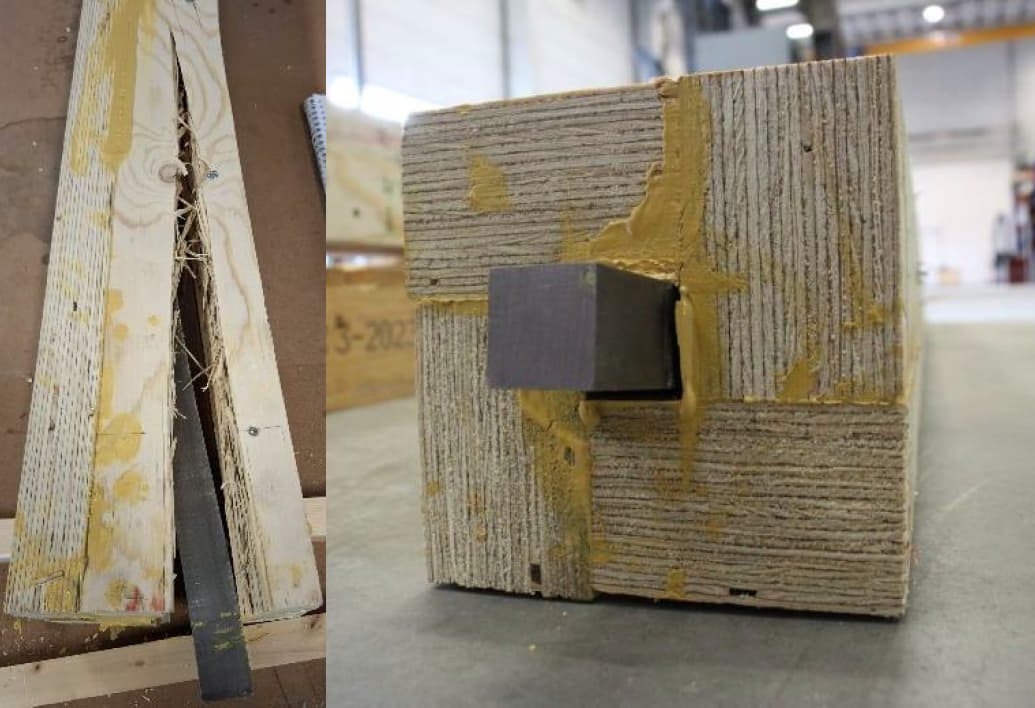
This thesis investigates the structural behavior of Timber Encased Steel Composite (TESC) columns to increase the load-bearing resistance of steel bars through the application of a biobased buckling restraint. This study involved conducting experimental tests on 14 columns, investigating three different connections between steel and LVL, together with three different end configurations of the columns. Bonding of steel and LVL was performed using a two component structural epoxy. The non-adhesively bonded behavior and the presence of a gap surrounding the steel bar were additionally investigated. These three variations were tested using two different extension lengths of the steel beyond the timber buckling restraint and by using a flush end configuration. A load-bearing increase of the extended steel columns up to four times was found by experimental testing. Local brittle failure of the LVL casing with reduced midspan buckling ultimately resulted in failure of the extended steel TESC columns, while the flush columns failed by global flexural buckling. The load-bearing enhancement of flush columns could not be determined as forces on the inner steel were not individually measured. The buckling imperfection factor described in EC3 was determined, from which it resulted that no clear buckling curve could be attributed to these flush TESC columns.
Finite Element (FE) models were developed and validated against the experimental test results, showing consistency for both the ultimate loading and deflection. The numerical validation models capture the initial deflection less accurately. A numerical parameter study was conducted on the flush columns due to their consistent failure mode. The numerical results indicated a substantial increase in load-bearing resistance of the TESC column compared to the unreinforced steel column. This enhancement is attributed to the application of a timber buckling restraint. Depending on the applied steel strength and timber properties, a load-bearing resistance increase up to 13 times the bare steel column was found. The load enhancement factor increased with a decreasing ratio of the axial stiffness ratio (EAs/EAt). The load-bearing resistance of the TESC columns also increased compared to the bare square timber columns.
The research concludes with an evaluation of the proposed design framework discussed in Eurocode 3 (EC3) and Eurocode 4 (EC4). A comparison between the numerical results from the parameter study and
the standardized buckling curves presented in EC3 was made. TESC columns using LVL48P and glue laminated timber (GLT) of strength classes GL24H and GL28H were considered for this comparison. Although no single buckling curve could accurately describe the obtained results, a significant upgrade to an increased buckling curve is obtained compared to the prescribed buckling curve for solid bars. Therefore, further research is recommended to refine the verification framework proposed in this study.
Keywords: Timber Encased Composite Columns, TESC, LVL, Hybrid timber-steel column
Cite this: Structural behavior of Timber Encased Steel Composite (TESC) columns under axial compression
Meel, van, S. (Author). 22 Jun 2026
Access to document(s):